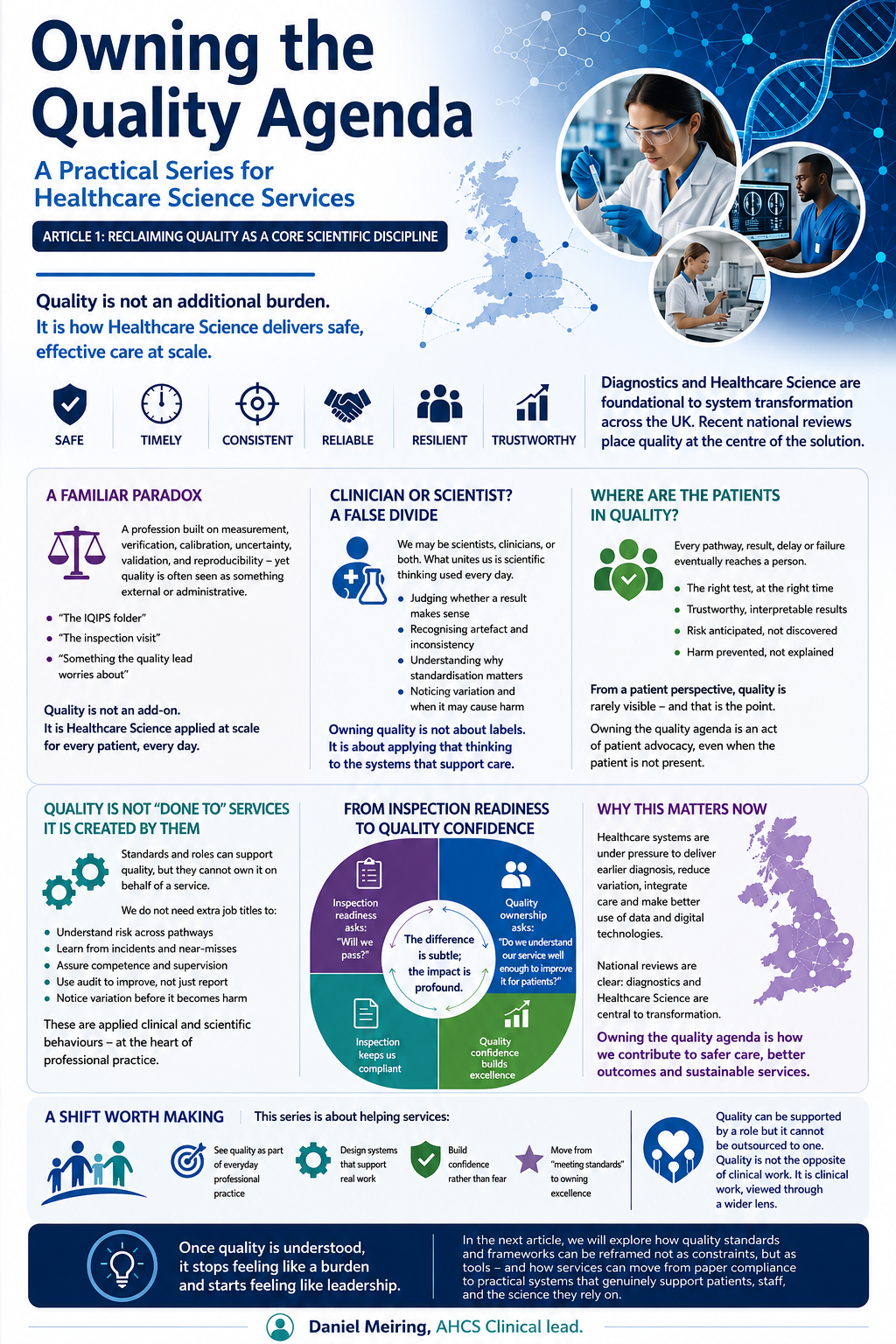

A Practical Series for Healthcare Science Services
Article 1: Reclaiming Quality as a Core Scientific Discipline by Daniel Meiring, AHCS Clinical Lead

Series preamble
Across the UK, Healthcare Science services are operating in a period of sustained pressure and rapid change. Demand is rising, pathways are becoming more complex, and expectations around safety, timeliness, and consistency are increasing often without corresponding growth in capacity.
National strategies across England, Wales, Scotland, and Northern Ireland are strikingly aligned in their intent. Whether framed around prevention, earlier diagnosis, digital transformation, integration, or population health, they all depend on diagnostic and scientific services that are reliable, resilient, and trustworthy.
Recent national reviews including the Kingdon Review and the Richards Review make this explicit. They identify diagnostics and Healthcare Science not as supporting functions, but as foundational to system transformation. Both highlight variation, fragility, and workforce sustainability as critical risks and both implicitly place quality at the centre of the solution.
This series is written to support Healthcare Science services in responding to that challenge by owning the quality agenda confidently, proportionately, and in a way that reflects real clinical and scientific work.
Because quality is not an additional burden. It is how Healthcare Science delivers safe, effective care at scale.
A familiar paradox
There is a strange paradox in Healthcare Science. We are a profession built on measurement, verification, calibration, uncertainty, validation, and reproducibility and yet many of us still talk about quality as if it were something external, administrative, or faintly irritating.
Quality becomes “the IQIPS folder”.
Or “the inspection visit”.
Or “something the quality lead worries about”.
Increasingly, it is framed as something we cannot fully do because a Trust or Health Board has not invested in a dedicated quality role. This is understandable but it is also quietly limiting.
Because in doing so, we give away something that should sit at the very heart of our professional identity.
Quality is not an add-on to Healthcare Science. It is Healthcare Science applied at scale taking the same rigour we use for individual clinical decisions and applying it to how whole services work, for every patient, every day.
Clinician or scientist? A false divide
Across Healthcare Science, people describe themselves in different ways.
Some strongly identify as scientists.
Some primarily see themselves as clinicians.
Many move fluidly between the two without ever needing to name it.
And that is entirely appropriate.
Owning the quality agenda does not require anyone to stop being a clinician or to adopt a different professional identity. It asks us to recognise that much of what we already do clinically is rooted in scientific reasoning.
Whether we describe ourselves as scientists, clinicians, or something in between, most of us already use scientific thinking every day:
- judging whether a result makes sense in context
- recognising artefact and inconsistency
- understanding why standardisation matters
- noticing variation and knowing when it may cause harm
We may not label these behaviours as “science”.
We may simply call them good clinical practice.
But they are, at their core, scientific ways of thinking applied in service of patients.
Owning quality is not about labels. It is about applying that same thinking to the systems that support care.
Where are the patients in quality?
Even in specialties that are a step removed from direct patient contact, the patient is never absent.
Every pathway, request, result, delay, or failure of reliability eventually reaches a person often at a moment of uncertainty or vulnerability.
Quality is how we ensure that:
- the right test happens at the right time
- results are trustworthy, interpretable, and timely
- risk is anticipated rather than discovered
- harm is prevented rather than retrospectively explained
Both the Kingdon and Richards reviews emphasise that unwarranted variation in diagnostics directly translates into variation in patient experience and outcomes. From a patient perspective, quality is rarely visible and that is often the point.
A high-quality service is one where patients do not need to worry about whether the system around them is functioning.
Owning the quality agenda is therefore an act of patient advocacy, even when the patient is not physically present.
Quality is not “done to” services it is created by them
A persistent myth is that quality arrives when a role is created or a standard is applied from the outside.
In reality, standards, reviews, and quality posts can only ever support what good already looks like when a service understands itself.
The Kingdon Review is clear that workforce expansion alone will not address diagnostic fragility without strong local systems, governance, and assurance. Likewise, the Richards Review highlights that recovery and transformation depend on services being able to understand and improve their own performance not simply increase throughput.
Dedicated quality expertise adds value.
It can coordinate activity, provide structure, and reduce duplication.
But it cannot own quality on behalf of a service.
When we say, “We can’t really do quality properly because we don’t have a quality lead,” we unintentionally reinforce the idea that quality belongs to someone else.
Many of the most impactful elements of quality require no additional job title:
- understanding risk across pathways
- learning from incidents and near-misses
- assuring competence and supervision
- using audit to improve care, not just report it
- noticing variation before it becomes harm
These are applied clinical and scientific behaviours and they sit squarely within professional practice.
From inspection readiness to quality confidence
Many services operate in a state of inspection readiness.
Documents are refreshed shortly before a visit.
Audits happen in bursts.
Policies exist but only a few people know where to find them.
This may keep organisations compliant.
It rarely builds confidence.
Quality confidence looks different:
- staff understand why systems exist, not just that they exist
- senior professionals can describe service risks without reaching for a file
- data is used to learn, not to defend
- improvement is routine, not reactive
Inspection readiness asks: “Will we pass?”
Quality ownership asks: “Do we understand our service well enough to improve it for patients?”
The difference is subtle and profound.
Why this matters now
Across the UK, healthcare systems are being asked to deliver earlier diagnosis, reduce unwarranted variation, integrate services, and make better use of data and digital technologies.
Healthcare Science sits at the junction of all of these ambitions.
National reviews have made it clear that diagnostics and scientific services are not peripheral to transformation they are central to it. Owning the quality agenda is therefore not optional.
It is how Healthcare Science contributes meaningfully to safer care, better outcomes, and sustainable services.
A shift worth making
This series is not about turning Healthcare Science professionals into compliance experts.
It is about helping services:
- see quality as part of everyday professional practice
- design systems that support real work
- build confidence rather than fear
- move from “meeting standards” to owning excellence
Quality can be supported by a role but it cannot be outsourced to one.
Quality is not the opposite of clinical work.
It is clinical work, viewed through a wider lens.
In the next article, we will explore how quality standards and frameworks can be reframed not as constraints, but as tools and how services can move from paper compliance to practical systems that genuinely support patients, staff, and the science they rely on.
Because once quality is understood, it stops feeling like a burden and starts feeling like leadership.